

Modern enterprises operate in an always-on digital economy where downtime directly translates into lost revenue, damaged reputation, regulatory risk, and diminished customer trust. Applications now run across complex hybrid and multi-cloud environments composed of microservices, containers, APIs, edge devices, and third-party integrations. This complexity has pushed traditional DevOps practices to their limits.
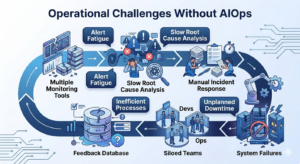
While DevOps successfully accelerated software delivery and improved collaboration between development and operations teams, it also introduced new operational challenges: massive telemetry data volumes, alert fatigue, unpredictable system behavior, and increasingly sophisticated failure modes. Human-driven monitoring and manual incident response can no longer keep pace with the scale and speed of modern systems.
This is where AI-Driven DevOps Automation, commonly known as AIOps becomes transformational.
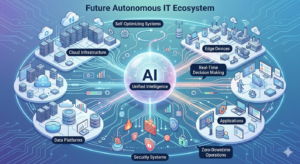
AIOps leverages artificial intelligence, machine learning, and advanced analytics to predict failures before they occur, automatically resolve incidents, optimize system performance, and continuously improve operational efficiency. Instead of reacting to outages, organizations can move toward predictive and self-healing operations.
For technology leaders, AIOps is not merely an operational enhancement. It is a strategic capability that enables digital resilience, faster innovation cycles, improved service reliability, and sustainable scaling of complex IT ecosystems.
Industry Overview & Key Concepts
Before implementing AIOps, it is essential to understand the underlying drivers and foundational principles that define predictive operations.
The Evolution from Reactive IT to Predictive Operations
Traditional IT operations followed a reactive model:
Monitor systems
Detect anomalies
Raise alerts
Investigate incidents
Apply fixes
This approach leads to prolonged downtime and operational inefficiencies.
Modern enterprises require a proactive model where systems anticipate problems and take corrective action automatically.
What Is AIOps?
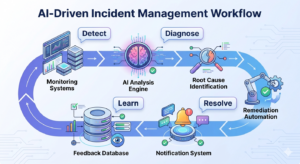
AIOps applies AI techniques to IT operations data logs, metrics, traces, events, and configuration changes to generate actionable insights and automate responses.
Core capabilities include:
Anomaly detection
Root cause analysis
Predictive failure modeling
Intelligent alert correlation
Automated remediation
Capacity forecasting
Performance optimization
Why DevOps Needs AI
DevOps environments generate enormous data volumes. A large enterprise system can produce millions of events per day, far exceeding human analysis capacity.
AI enables:
Pattern recognition across massive datasets
Real-time decision making
Reduction of noise from false alerts
Identification of hidden dependencies
Continuous learning from past incidents
Business Drivers for AIOps Adoption
As organizations navigate increasingly complex and fast-paced digital environments, there is a growing need to ensure operational efficiency, system reliability, and seamless user experiences. AIOps enables businesses to move toward intelligent, automated operations that align IT performance with strategic goals and long-term scalability.
Higher system availability
Reduced operational costs
Faster incident resolution
Improved customer experience
Support for digital transformation
Scalable cloud operations
Core Framework: AIOps Methodology for Predictive Operations
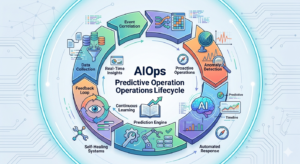
AIOps implementation requires a structured framework that integrates data ingestion, intelligent analytics, and automated execution. By combining machine learning with operational workflows, organizations can transition from reactive monitoring to predictive, self-healing systems that enhance performance, reliability, and scalability across complex IT environments.
Stage 1: Data Aggregation and Normalization
Aggregation of multi-source data including infrastructure metrics, application logs, distributed traces, network telemetry, configuration data, and business transactions. Normalization ensures unified data formats, enabling cross-platform correlation, improved data quality, and consistent analytical accuracy across diverse and distributed systems.
Stage 2: Intelligent Event Correlation
AI-driven correlation of high-volume events to eliminate redundancy and noise. Pattern recognition techniques group related alerts, reduce alert fatigue, and prioritize critical incidents, enabling faster triaging and improved operational focus in complex, event-driven IT environments.
Stage 3: Anomaly Detection
Machine learning models establish dynamic behavioral baselines and detect deviations in real time. Adaptive thresholding replaces static rules, enabling early identification of abnormal system behavior, performance irregularities, and hidden issues that may indicate potential failures.
Stage 4: Predictive Failure Analysis
Advanced analytics leverage historical and real-time data to forecast risks such as resource exhaustion, performance degradation, service disruption, and capacity limitations. Predictive insights enable proactive intervention, minimizing downtime and ensuring continuity of business-critical operations.
Stage 5: Automated Remediation
Execution of predefined automation workflows to resolve incidents without manual intervention. Actions include service restarts, resource scaling, deployment rollbacks, and system reconfiguration, enabling rapid recovery, reduced mean time to resolution, and the development of self-healing infrastructure.
Stage 6: Continuous Learning and Optimization
Continuous model refinement through feedback loops and incident learning. Systems improve prediction accuracy, response effectiveness, and operational efficiency over time, enabling adaptive intelligence and sustained optimization in evolving IT and DevOps ecosystems.
How Round The Clock Technologies Delivers AIOps Solutions
Round The Clock Technologies provides comprehensive AIOps services that enable enterprises to transition from reactive operations to intelligent, predictive environments.
Strategic Consulting Approach
Engagements begin with a comprehensive assessment of DevOps maturity, operational bottlenecks, business objectives, and the existing technology landscape. Based on these insights, experts craft a strategic roadmap that aligns transformation initiatives with long-term organizational goals and measurable outcomes.
Implementation Methodology
A structured implementation methodology ensures seamless execution across all stages, including observability assessment, data integration, AI model deployment, and automation workflow design. This approach progresses through pilot implementation, enterprise-wide rollout, and continuous optimization to deliver scalable, efficient, and intelligent DevOps operations.
Technology Expertise
The organization brings deep technical expertise across modern cloud platforms, microservices-based architectures, advanced AI technologies, and enterprise DevOps ecosystems. This strong foundation enables the delivery of innovative, resilient, and future-ready solutions tailored to evolving business and operational requirements.
Engineering Capabilities
Specialized engineering teams focus on designing and implementing scalable monitoring systems, predictive analytics engines, and automated remediation frameworks. These capabilities ensure proactive issue detection, faster resolution, and enhanced system reliability, enabling organizations to maintain uninterrupted and high-performing digital environments.
Tools, Platforms, and Frameworks Used
Solutions are built using industry-leading observability platforms, automation tools, machine learning frameworks, and cloud-native technologies. This diverse technology stack enables seamless integration, enhanced visibility, and intelligent automation, ensuring efficient management of complex and dynamic IT environments.
Industry Experience and Domain Knowledge
With extensive experience across industries such as finance, healthcare, retail, and technology, the organization understands domain-specific challenges and regulatory requirements. This expertise allows for the delivery of tailored solutions that align with industry standards while addressing unique operational needs.
Enabling Scalability, Performance, Reliability and Transformation
By embedding intelligence into DevOps processes, the organization empowers businesses to maintain high availability, optimize resource utilization, and accelerate innovation. This approach supports confident scaling of digital initiatives while ensuring performance, reliability, and continuous transformation in a competitive landscape.