
Software quality assurance is undergoing one of the most significant transformations in its history. Traditional testing models were built for slower release cycles, stable architectures, and predictable deployment schedules. Today, organizations operate in a very different environment shaped by cloud-native systems, continuous integration pipelines, distributed applications, and rising customer expectations for flawless digital experiences.
Modern QA teams are no longer responsible only for validating functionality before release. They are now expected to help prevent production failures, accelerate release confidence, improve customer experience, and support engineering velocity. This shift has created a need for more intelligent and proactive quality operations.
That is where AIOps for QA is becoming highly valuable.
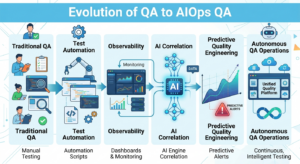
AIOps, or Artificial Intelligence for IT Operations, combines machine learning, analytics, automation, and observability to detect issues faster and improve operational decision-making. When applied to QA, AIOps transforms testing from a reactive activity into a continuous intelligence engine that monitors systems, identifies anomalies, prioritizes failures, and accelerates root cause analysis.
Instead of spending hours reviewing logs, dashboards, screenshots, failed pipelines, and duplicate alerts, engineering teams can use AI-driven systems to surface likely causes within minutes. This improves software reliability while reducing operational pressure across QA, DevOps, and engineering teams.
Organizations investing in AIOps for QA are improving release quality, reducing downtime, and creating more resilient digital ecosystems.
Understanding the Industry Need for AIOps in QA
Quality assurance has become more complex because software delivery itself has become more complex. A single customer transaction may now involve mobile apps, APIs, third-party integrations, databases, authentication layers, payment gateways, and multiple microservices. A defect in one component can quickly impact many others.
Traditional testing practices often fail to provide complete visibility in such environments. Even when automation coverage is high, teams still face recurring issues such as flaky tests, false failures, slow defect triage, performance bottlenecks, and delayed releases.
Several industry trends are accelerating AIOps adoption in QA:
Frequent release cycles: Many enterprises now release weekly, daily, or even multiple times per day. Manual quality review models cannot scale efficiently under this level of deployment frequency and operational pressure.
Complex distributed systems: Applications built on microservices, containers, APIs, and hybrid cloud environments generate thousands of operational signals that are difficult to interpret manually during failures.
Customer experience sensitivity: Users expect fast, always-available digital services. Even minor latency, checkout failures, login errors, or crashes can result in immediate churn and reputational damage.
Alert fatigue across teams: Large engineering organizations often receive too many alerts from different tools, making it difficult to identify what truly requires urgent attention.
Pressure to optimize costs: Enterprises need better quality outcomes without endlessly expanding headcount, making intelligent automation increasingly attractive.
These realities explain why modern organizations are moving toward AI-powered quality engineering.
What AIOps for QA Really Means
AIOps for QA is not simply adding AI to a testing tool. It is the integration of operational intelligence into the entire quality lifecycle.
This means test results are no longer reviewed in isolation. They are correlated with application logs, infrastructure metrics, deployment changes, user behavior data, code commits, historical defect patterns, and production telemetry.
The result is a smarter quality ecosystem capable of answering critical questions quickly:
Why did this test fail today but pass yesterday?
Is this failure caused by code, environment instability, or external dependency issues?
Which modules are most likely to fail in the next release?
Should this release proceed or be delayed?
Which incidents need urgent attention right now?
AIOps helps QA teams shift from collecting information to acting on insights.
Core Framework of AIOps for QA
Successful AIOps implementation in QA usually follows a structured operating model. Rather than adopting isolated tools, enterprises should build a connected framework where data, intelligence, and action work together. Four key AIOps frameworks for QA are outlined below:
Unified Data Foundation
The first step is consolidating signals from all relevant systems. This includes CI/CD pipelines, test automation suites, defect tools, application logs, cloud metrics, incident platforms, and user analytics. Without connected data, AI models cannot produce meaningful recommendations.
Intelligent Detection Layer
Machine learning models monitor patterns across historical and real-time data to detect unusual behavior. This may include sudden test failures, abnormal response times, infrastructure instability, or recurring release regressions that human teams may overlook initially.
Correlation and Root Cause Layer
This is where AIOps delivers major value. Instead of treating alerts separately, the platform correlates recent deployments, service dependencies, code changes, logs, and failed tests to identify the most probable cause of an issue.
Automated Response Layer
Once confidence levels are high, organizations can automate actions such as rerunning impacted tests, opening incident tickets, notifying owners, blocking risky releases, or escalating severe quality failures immediately.
Continuous Learning Layer
As incidents are resolved, the system learns from outcomes. Over time, recommendations become more accurate, false positives decrease, and quality intelligence improves.
Intelligent Monitoring in Modern QA
Monitoring has traditionally been associated with production operations teams. However, in high-performing organizations, monitoring now starts much earlier in the lifecycle.
QA teams increasingly need visibility into build health, test stability, environment readiness, API behavior, release drift, performance patterns, and synthetic user journeys. Intelligent monitoring enables this continuous visibility.
Benefits of intelligent monitoring include:
Early anomaly detection: AI models identify unusual patterns in response times, error spikes, unstable environments, or sudden test failures before users experience visible disruption or teams lose valuable investigation time.
Smarter release confidence: Monitoring trends across builds helps leaders decide whether software quality is improving, stable, or declining before approving production deployment decisions.
Reduced noise from false alarms: Intelligent thresholds adapt to historical baselines instead of relying only on static rules, which lowers unnecessary alerts and improves focus.
Business-aligned quality visibility: Teams can connect technical quality indicators to customer journeys such as sign-up flows, payments, or order completion rates.
Automated Root Cause Analysis: The Game Changer
One of the most expensive parts of software quality failure is not detection. It is diagnosis.
Many enterprises detect issues quickly but still spend hours identifying the actual cause. Multiple teams may join calls, review logs, debate ownership, and duplicate effort before resolution begins.
Automated root cause analysis changes this model.
When a major failure occurs, AIOps engines compare current conditions against historical patterns, review recent deployments, inspect dependency relationships, analyze logs, and rank likely causes.
For example, if checkout tests fail immediately after a payment service deployment while CPU spikes occur on one node, the platform may prioritize infrastructure-resource contention linked to the new release.
This significantly reduces Mean Time to Resolution (MTTR) and restores business services faster.
Common Challenges Organizations Face
Despite clear benefits, many enterprises struggle during implementation because AIOps requires maturity across processes, tools, and data quality. Four key implementation challenges are outlined below:
Fragmented Toolchains
Most enterprises use separate platforms for testing, monitoring, CI/CD, ticketing, logging, and cloud operations. When systems do not communicate effectively, valuable context is lost and AI models become less effective.
Poor Data Hygiene
AI outcomes depend heavily on input quality. Inconsistent naming conventions, duplicate alerts, missing metadata, and weak tagging structures create confusion and lower model confidence.
Legacy Automation Suites
Older test frameworks often generate noisy results, brittle failures, and limited telemetry. Without modernization, these suites reduce AIOps effectiveness.
Organizational Silos
QA, DevOps, SRE, development, and operations teams may operate independently with different KPIs. AIOps requires shared ownership of reliability and quality outcomes.
Trust in AI Recommendations
Teams may initially hesitate to rely on automated RCA or release-risk scoring. Adoption improves when recommendations are transparent, measurable, and supported by human governance.
Best Practices for Successful Implementation
Enterprises that achieve strong results usually take a phased and strategic approach rather than attempting full transformation immediately.
Begin with one high-value use case: Start with flaky test reduction, failed build triage, or release risk scoring. Early measurable wins build executive confidence and create momentum for broader adoption.
Standardize telemetry data first: Define service naming conventions, environment tags, ownership metadata, severity labels, and incident categories so machine learning models receive reliable structured inputs.
Modernize automation frameworks: Replace unstable legacy scripts with maintainable, observable frameworks that generate rich execution data and integrate cleanly with CI/CD systems.
Create shared operating metrics: Align QA, DevOps, and engineering teams around MTTR, escaped defects, release frequency, test stability, and customer experience indicators.
Use human-in-the-loop governance: Keep approval checkpoints for high-impact automated decisions such as release blocking, rollback triggers, or production escalations until confidence matures.
Practical Enterprise Example
A retail organization running frequent promotional campaigns experienced repeated failures during peak traffic releases. QA teams found automation failures, while operations teams saw performance alerts, but neither group had a complete picture.
After implementing AIOps for QA, the organization connected pipeline data, logs, infrastructure metrics, and synthetic transaction monitoring.
Within three months:
Failure triage time dropped significantly
Repeated false alarms were reduced
Release confidence improved during high-demand events
Production incidents linked to quality regressions decreased
Cross-functional collaboration improved substantially
The most valuable gain was not only faster issue resolution, but stronger executive trust in release readiness.
Future Trends in AIOps for QA
The next generation of quality engineering will become more autonomous, predictive, and business-aware, helping organizations move beyond traditional testing toward smarter and faster quality practices. Four key trends shaping the future of quality engineering are outlined below:
Generative AI for Testing
AI systems will create test cases, summarize failures, generate RCA reports, and recommend remediation steps using natural language interfaces.
Self-Healing Quality Pipelines
Automation suites will detect broken selectors, unstable environments, and dependency issues, then correct or reroute execution automatically.
Predictive Release Governance
Future platforms will score every release based on historical quality patterns, architecture risk, change volume, and operational readiness.
Unified Shift-Left and Shift-Right Quality
Development-time code quality and production-time customer experience data will combine into one continuous quality intelligence model.
AI Agents for Engineering Operations
Dedicated AI agents may soon coordinate testing, monitoring, defect prioritization, and release assurance with minimal manual intervention.
How Round The Clock Technologies Delivers These Services
AIOps success requires more than tool deployment. It demands strategy, integration expertise, engineering discipline, and measurable business outcomes. Round The Clock Technologies helps enterprises modernize QA operations through intelligent automation and scalable delivery models. Four key capabilities that drive successful AIOps transformation are outlined below:
Strategic Consulting Approach
The engagement begins with a current-state assessment covering QA maturity, monitoring readiness, toolchain effectiveness, defect patterns, and operational bottlenecks. This enables a realistic transformation roadmap aligned to business priorities.
Implementation Methodology
Round The Clock Technologies follows a phased model that includes discovery, architecture planning, telemetry integration, pilot implementation, KPI measurement, and enterprise-scale rollout. This reduces risk while accelerating time to value.
Technology Expertise
The team works across leading platforms such as Selenium, Cypress, Playwright, Jenkins, Azure DevOps, GitHub Actions, Splunk, Datadog, Grafana, ELK, cloud observability tools, and AI-enabled analytics ecosystems.
Engineering Capabilities
Capabilities extend across test automation modernization, performance engineering, DevSecOps integration, CI/CD optimization, release governance, reliability engineering, and intelligent monitoring operations.
Industry Experience
Round The Clock Technologies supports organizations across banking, healthcare, retail, telecom, manufacturing, and digital product ecosystems where quality, uptime, compliance, and speed are business critical.
Business Outcomes Delivered
Clients benefit from stronger release confidence, lower defect leakage, faster root cause analysis, improved operational visibility, reduced downtime, and scalable digital transformation.
Conclusion
AIOps for QA is redefining how modern enterprises achieve software quality. Instead of reacting to failures after impact, organizations can now predict risks, monitor intelligently, and resolve issues faster through automation and AI-driven insights.
As software ecosystems continue to grow more complex, quality leadership will increasingly depend on intelligence rather than effort alone.
Round The Clock Technologies enables enterprises to adopt this future-ready model with the strategy, engineering expertise, and execution discipline needed to turn AIOps into measurable business value.