

In today’s digital-first economy, cost optimization is no longer limited to budget control, it has evolved into a strategic engineering priority. Enterprises are expected to deliver faster, scale efficiently, and continuously innovate, all while maintaining cost discipline.
Traditional development models often dependent on manual processes, siloed teams, and duplicated efforts are increasingly becoming inefficient and expensive. This is where smart automation and reusable components are transforming how modern organizations build and operate software systems.
Organizations adopting these practices are seeing measurable impact:
30–50% reduction in operational costs, driven by minimized manual effort
Faster release cycles, enabled through automation pipelines
Improved software quality, due to reduced human error and standardized processes
This article explores how enterprises can strategically implement automation and reusability to achieve sustainable cost optimization.
Industry Overview/Key Concepts
To understand how cost optimization works in practice, it is essential to first look at the core concepts driving this transformation.
Understanding Smart Automation
Smart automation goes beyond basic scripting and introduces intelligence into workflows, enabling systems to operate with minimal manual intervention.
AI-driven workflows allow systems to make decisions based on data patterns, reducing dependency on human inputs.
Automated testing frameworks ensure that applications are validated continuously without manual effort.
CI/CD pipelines streamline integration and deployment, ensuring faster and more reliable releases.
Real-time monitoring systems detect and resolve issues proactively, improving system stability.
Together, these capabilities help organizations improve efficiency while reducing operational overhead.
What Are Reusable Components?
Reusable components focus on eliminating redundancy by enabling teams to leverage existing assets across projects.
Code libraries provide pre-built functionalities that can be reused instead of developed from scratch.
APIs and microservices expose standardized services that can be consumed across applications.
UI component libraries ensure consistent user experience while reducing design effort.
Test scripts and frameworks can be reused across multiple test cycles, saving time and effort.
Infrastructure templates (IaC) allow teams to replicate environments quickly and reliably.
This approach significantly accelerates development while maintaining consistency and quality.
Why This Matters Today
The increasing complexity of digital ecosystems makes automation and reusability essential rather than optional.
Cloud-native architectures demand modular and scalable systems to handle dynamic workloads.
DevOps adoption requires continuous automation to maintain speed and efficiency.
Competitive markets push organizations to reduce time-to-market for new features.
Rising engineering costs make efficiency a critical business priority.
Organizations that fail to adopt these practices often struggle with higher costs and slower innovation cycles.
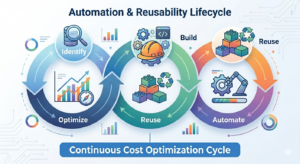
Core Framework: Automation & Reusability Optimization Model
A structured framework is essential to embed automation and reusability effectively across the software lifecycle.
Identify Automation Opportunities
The first step is to identify processes where automation can deliver maximum value. These are typically repetitive and time-intensive tasks.
Manual testing processes consume significant time and are prone to human errors, making them ideal candidates for automation.
Deployment workflows often involve multiple steps that can be streamlined through automated pipelines.
Monitoring and alerting systems benefit from automation by enabling faster detection and resolution of issues.
Data processing tasks can be automated to handle large volumes efficiently and consistently.
Focusing on these areas ensures quick wins and strong ROI from automation initiatives.
Build a Reusable Asset Repository
After identifying automation opportunities, organizations should focus on creating reusable assets that can be leveraged across teams.
Shared code modules help teams avoid rebuilding common functionalities, saving development time.
Automation scripts can be standardized and reused across projects, ensuring consistency.
Test frameworks provide a structured approach to testing, improving efficiency and reliability.
Infrastructure templates enable rapid environment setup and reduce configuration errors.
A centralized repository ensures these assets remain accessible, consistent, and well-governed.
Implement CI/CD Pipelines
CI/CD pipelines play a crucial role in enabling automation across the development lifecycle.
Continuous integration ensures that code changes are automatically built and validated as they are introduced.
Automated testing pipelines run tests continuously, reducing delays and improving quality.
Continuous deployment workflows enable faster releases with minimal manual intervention.
Rollback mechanisms ensure that failures can be quickly addressed without impacting users.
This significantly enhances speed, reliability, and consistency in software delivery.
Standardize Architecture
To fully leverage reusable components, systems must be designed with modularity and scalability in mind.
Microservices-based architecture breaks applications into smaller, independent services, making them easier to reuse and scale.
API-first development ensures that functionalities are accessible and reusable across systems.
Containerization technologies such as Docker and Kubernetes provide consistency across environments and simplify deployment.
A standardized architecture ensures seamless integration and maximizes the value of reusable components.
Continuous Optimization
Cost optimization is an ongoing process that requires continuous monitoring and improvement.
Performance metrics help identify inefficiencies and track improvements over time.
Resource utilization analysis ensures optimal use of infrastructure, reducing unnecessary costs.
Automation performance reviews highlight areas where processes can be further optimized.
Feedback loops enable teams to refine strategies based on real-world outcomes.
This ensures long-term sustainability and continuous value generation.
Key Challenges Organizations Face
Even with a well-defined framework in place, implementing smart automation and reusable components is not always straightforward. Organizations often encounter a set of practical challenges that can slow down adoption and impact overall outcomes if not addressed proactively.
Integration Complexity
One of the most common challenges is integrating modern automation tools with existing legacy systems.
Legacy systems often lack compatibility with modern tools, making it difficult to directly implement automation without additional customization or middleware. This increases both time and effort during implementation.
Bridging old and new technologies requires specialized expertise, as teams must ensure that new solutions work seamlessly without disrupting existing operations.
This complexity often becomes a major bottleneck, especially for organizations with deeply embedded legacy infrastructures.
Cultural Resistance
Technology transformation is not just about tools, it also involves people and processes.
Teams may resist change due to unfamiliarity with automation tools, fearing disruption to their existing workflows or roles. This hesitation can slow down adoption significantly.
Lack of collaboration across teams further impacts progress, as automation and reuse require cross-functional alignment between development, testing, and operations teams.
Without a strong change management strategy, even the best technical solutions may fail to deliver expected results.
Initial Investment
While automation and reusable components drive long-term cost savings, the initial setup requires careful investment.
Automation tools, platforms, and infrastructure demand upfront costs, which organizations must plan for strategically.
Training and upskilling efforts add to the initial investment, as teams need to develop expertise in new technologies and frameworks.
Although the return on investment is significant over time, this initial phase often requires strong executive support and planning.
Governance Issues
Sustaining the benefits of reusable components depends heavily on proper governance.
Without defined standards and guidelines, reusable components can become inconsistent, reducing their effectiveness and leading to duplication instead of reuse.
Lack of version control and ownership can create confusion, making it difficult for teams to identify and use the right components.
Establishing strong governance ensures that reusable assets remain reliable, scalable, and easy to adopt.
Skill Gaps
Successful implementation of automation and reusability requires specialized skills that are often in short supply.
A shortage of DevOps and automation expertise can limit execution, as organizations may struggle to design and implement efficient workflows.
Limited knowledge of cloud-native technologies slows adoption, particularly when transitioning to modern architectures such as microservices and containerization.
Bridging these skill gaps through training and hiring is essential for achieving long-term success.
Best Practices and Implementation Strategies
To successfully overcome implementation challenges and unlock the full value of smart automation and reusable components, organizations must adopt a set of proven best practices. These strategies not only improve efficiency but also ensure long-term sustainability and scalability.
Adopt a Shift-Left Approach
A shift-left approach focuses on introducing automation and testing early in the software development lifecycle rather than waiting until later stages.
Introducing automation early helps detect defects sooner, allowing teams to address issues before they escalate into larger problems. This significantly reduces rework effort and associated costs.
Early validation improves overall software quality, as continuous testing ensures that defects are identified and resolved at the right stage, minimizing downstream risks.
By shifting quality checks to the beginning of the lifecycle, organizations can build more reliable systems while optimizing costs.
Design for Reusability
Reusability must be an intentional design decision rather than an afterthought. Systems and components should be built in a way that they can be easily reused across projects.
Modular components ensure scalability and flexibility, enabling teams to use the same building blocks across multiple applications without major changes.
Proper documentation makes components easier to adopt and reuse, as it provides clear guidance on how they should be implemented and integrated.
Designing with reusability in mind reduces duplication, accelerates development, and ensures consistency across systems.
Invest in the Right Tools
The effectiveness of automation largely depends on the tools and platforms used to implement it. Selecting the right technology stack is critical for success.
CI/CD platforms enable seamless automation of development workflows, allowing teams to integrate, test, and deploy code efficiently with minimal manual intervention.
Automation frameworks improve testing efficiency and consistency, ensuring that applications are validated thoroughly across different environments.
Investing in the right tools creates a strong foundation for scalable and efficient automation practices.
Establish Governance Models
Governance plays a crucial role in maintaining the effectiveness of reusable components and automation processes over time.
Defining ownership ensures accountability for reusable assets, making it clear who is responsible for maintaining and updating components.
Version control maintains consistency and reliability, ensuring that teams always use the correct and most up-to-date versions of components.
Strong governance ensures that automation and reusability efforts remain organized, scalable, and sustainable.
Measure and Optimize
Continuous measurement and improvement are essential to ensure that automation and reusability deliver the expected outcomes.
Tracking key metrics such as deployment frequency and defect rates helps measure performance, providing insights into the effectiveness of implemented strategies.
Continuous improvement ensures sustained cost optimization, as organizations can refine their processes based on real-time data and evolving requirements.
By adopting a data-driven approach, organizations can continuously enhance efficiency and maximize long-term value.
How Round The Clock Technologies Delivers These Services
Round The Clock Technologies enables organizations to achieve cost optimization through a structured, outcome-driven approach that combines strategic consulting, automation, and reusable engineering practices. The focus remains on delivering scalable solutions with measurable business impact.
Strategic Consulting Approach
A strong foundation begins with understanding the current landscape and defining the right direction.
Identify automation and reuse opportunities aligned with business goals
Define a clear, customized roadmap for transformation
Implementation Methodology
Execution is designed to ensure smooth adoption and continuous value delivery.
Structured implementation approach for seamless integration
Phased adoption model to minimize disruption and maximize impact
Technology Expertise
Deep technical capabilities enable scalable and future-ready solutions.
DevOps and CI/CD expertise for faster, streamlined delivery
Cloud and microservices capabilities for scalability and flexibility
Engineering Capabilities
Strong engineering practices ensure efficiency, performance, and reliability.
Scalable automation frameworks to reduce manual effort
Reusable component libraries to accelerate development
Tools, Platforms, and Frameworks
A robust technology stack supports efficient execution across the lifecycle.
CI/CD tools (Jenkins, GitLab) for automated delivery
Automation tools (Selenium, Cypress) for consistent testing
Container platforms (Docker, Kubernetes) for scalable deployment
Industry Experience and Domain Knowledge
Domain expertise ensures solutions are relevant and impactful.
Cross-industry experience across BFSI, healthcare, retail, and tech
Domain-aligned solutions tailored to business needs
Business Outcomes and Value Delivery
The overall approach ensures measurable and sustainable results.
Reduced costs through automation and optimization
Faster delivery with streamlined workflows
Improved reliability via standardized components
Accelerated transformation with scalable architectures