
Digital accessibility has moved beyond compliance checklists and into the core of user experience strategy. As digital platforms become more complex and user expectations continue to rise, organizations are under increasing pressure to ensure their applications are inclusive, usable, and compliant at all times.
Yet, achieving accessibility on a scale is not easy. Traditional approaches often fall short in dynamic environments where UI changes are frequent, and development cycles are rapid.
This is where Large Language Models (LLMs) are reshaping the conversation.
LLM-driven accessibility audits introduce intelligence, context, and automation into the process turning accessibility from a reactive activity into a proactive, continuous capability. This article explores how this transformation is unfolding and what it means for modern enterprises.
Industry Overview/Key Concepts
Before diving into how LLMs are transforming accessibility, it is important to understand the foundations of accessibility compliance and where current approaches fall short.
What is Accessibility Compliance?
At its core, accessibility compliance ensures that digital products can be used by everyone, regardless of ability.
It focuses on making interfaces inclusive for users with visual, auditory, cognitive, and motor impairments, guided by standards such as WCAG.
These standards are built around four key principles:
Perceivable
Operable
Understandable
Robust
Together, they define how inclusive a digital experience truly is.
Limitations of Traditional Accessibility Testing
While accessibility is widely recognized as important, the way it is tested often creates more challenges than solutions.
Traditional accessibility methods rely heavily on:
Manual audits that take time and effort
Rule-based tools that lack context
Periodic testing that misses ongoing issues
As a result, many accessibility gaps remain undetected.
What Are LLM-Driven Accessibility Audits?
To overcome these limitations, organizations are now turning to AI-driven solutions.
LLM-driven accessibility audits use advanced AI models to:
Understand UI elements contextually
Interpret accessibility guidelines in natural language
Detect issues beyond static rules
Suggest meaningful, actionable fixes
This marks a shift from simply finding issues to understanding and resolving them intelligently.
Core Framework: LLM-Driven Accessibility Audit Lifecycle
To fully understand the value of LLMs in accessibility, it helps to break down how the process works in a real-world scenario.
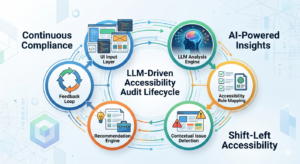
Step 1: UI Data Ingestion
Everything begins with understanding the interface.
LLMs collect and process data from multiple sources such as DOM structures, codebases, and user flows to build a complete picture of how the UI behaves.
Step 2: Contextual Analysis
Once the data is collected, the real intelligence begins.
Unlike traditional tools, LLMs evaluate not just what is present but what it means in a real user context.
Step 3: Accessibility Rule Mapping
With context in place, the system aligns UI elements with accessibility standards.
This includes mapping against WCAG, ADA requirements, and internal accessibility frameworks.
Step 4: Intelligent Issue Detection
Now comes the critical step identifying issues that truly impact users.
LLMs can detect:
Missing or irrelevant alt text
Poor contrast affecting readability
Incorrect ARIA roles
Navigation barriers
All with contextual awareness.
Step 5: Automated Recommendations
Detection alone is not enough resolution is key.
LLMs provide:
Code-level fixes
UI improvement suggestions
Content enhancements
This significantly reduces developer effort.
Step 6: Continuous Feedback Loop
Finally, the process doesn’t stop after one cycle.
Integrated into CI/CD pipelines, LLMs ensure accessibility is continuously monitored and improved over time.
Key Challenges Organizations Face
While the benefits of accessibility are undeniable, implementing it across large, complex systems introduces several practical challenges that organizations must address.
Fragmented Testing Ecosystems
Many organizations operate with multiple accessibility testing tools across different teams and projects. This fragmentation often results in inconsistent testing outcomes, duplication of efforts, and lack of a unified accessibility standard making it difficult to maintain reliability.
Lack of Accessibility Expertise
Accessibility is a specialized domain that requires a deep understanding of standards, guidelines, and user behavior. However, many teams lack the expertise needed to accurately interpret accessibility issues and implement effective fixes, which slows down progress.
Scalability Limitations
Manual accessibility testing becomes increasingly impractical as applications grow in size and complexity. With frequent releases, multiple platforms, and continuous updates, scaling manual efforts is both time-consuming and inefficient.
False Positives in Automation
Traditional automation tools often generate a high volume of alerts, many of which are not actionable. This leads to alert fatigue, reduced trust in automation, and wasted effort in filtering out irrelevant issues.
Integration Complexity
Integrating accessibility into existing development workflows requires changes across tools, processes, and team culture. Without a well-planned strategy, this transition can become complex and disruptive.
Best Practices and Implementation Strategies
To successfully implement LLM-driven accessibility, organizations should adopt a structured and practical approach that aligns technology with processes and people.
Shift Accessibility Left
Introducing accessibility early in the development lifecycle ensures that issues are identified and resolved before they escalate. Embedding checks during design and development stages minimizes rework and improves overall quality.
Combine AI with Human Expertise
While AI accelerates detection and analysis, human validation remains essential for handling complex, context-driven scenarios. A collaborative approach between AI and experts delivers the most accurate and reliable outcomes.
Standardize Accessibility Frameworks
Consistency across teams is critical. Establishing organization-wide accessibility guidelines and frameworks ensures alignment, reduces ambiguity, and improves implementation efficiency.
Integrate with DevOps Pipelines
Embedding accessibility checks within CI/CD pipelines enables continuous validation without disrupting delivery speed. This ensures accessibility becomes a seamless part of the development process rather than an afterthought.
Leverage Design Systems
Using pre-built, accessible design components reduces repetitive effort and ensures consistency across applications. It also helps teams maintain compliance more efficiently at scale.
Measure and Optimize
Tracking key accessibility metrics allows organizations to monitor progress, identify gaps, and continuously improve their accessibility maturity over time.
Future Trends and Industry Evolution
As AI technologies continue to evolve, accessibility is set to become more intelligent, automated, and user centric.
Self-Healing Accessibility Systems
Future systems will go beyond detection and will automatically resolve accessibility issues in real time, reducing the need for manual intervention.
Multimodal Accessibility Testing
By combining language models with vision-based AI, organizations will be able to detect deeper usability and visual accessibility issues that traditional tools often miss.
Personalized Accessibility Experiences
User interfaces will dynamically adapt to individual user needs, delivering more inclusive and customized digital experiences.
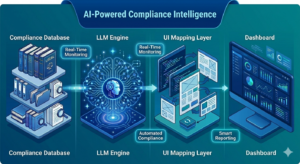
AI-Powered Compliance Intelligence
AI will continuously map regulatory requirements to UI components, enabling real-time monitoring, automated compliance, and smarter reporting across systems.
Accessibility as a Business KPI
Accessibility will evolve into a core business metric, measured alongside performance, security, and user experience reflecting its growing importance in digital success.
How Round The Clock Technologies Delivers LLM-Driven Accessibility Audits
Turning strategy into execution requires the right expertise, tools, and approach.
Round The Clock Technologies enables organizations to implement AI-driven accessibility with precision and scalability.
Strategic Consulting Approach
Every transformation begins with clarity.
The team evaluates current accessibility maturity, identifies gaps, and builds a roadmap aligned with business goals.
Technology Expertise
Advanced LLM models, automation frameworks, and AI-driven analytics power every implementation.
Engineering Capabilities
Robust DevSecOps pipelines and scalable architectures ensure seamless integration into enterprise environments.
Tools, Platforms, and Frameworks
A combination of AI tools, accessibility frameworks, and CI/CD integrations ensures continuous compliance.
Industry Experience and Domain Knowledge
Deep expertise across industries enables tailored solutions that align with real-world challenges.
Driving Scalability and Digital Transformation
The result is faster releases, reduced risks, and inclusive digital experiences at scale.
Our accessibility experts help organizations move from compliance challenges to accessibility leadership.